Art With Romeo Juliet as Theme Romeo and Juliet Inspired Art
As we are unsure of the appointment of William Shakespeare's birthday, it is traditionally celebrated around 23rd April, ironically the appointment of his death. This falls in springtime when, according to the poet Alfred, Lord Tennyson 'a young homo's fancy lightly turns to thoughts of dearest.'
This year, in particular, the lovelorn accept endured long periods of separation while they wait to exist reunited. By contrast, in Shakespeare's tragedy Romeo and Juliet, the headstrong immature lovers refuse to take the separation acquired by their warring families, and are impelled along a path which ultimately leads to their deaths.
The play has inspired fine art in all forms, from the musical Due west Side Story to Dire Straits' classic striking Romeo and Juliet, and Malorie Blackman'south novel Noughts and Crosses. Equally the success of the recent film of Romeo and Juliet from the National Theatre in London demonstrates, the story of the 'star-cross'd lovers' retains its powerful influence today.
Hither we look at what artists on Art Britain have made of this timeless tale.
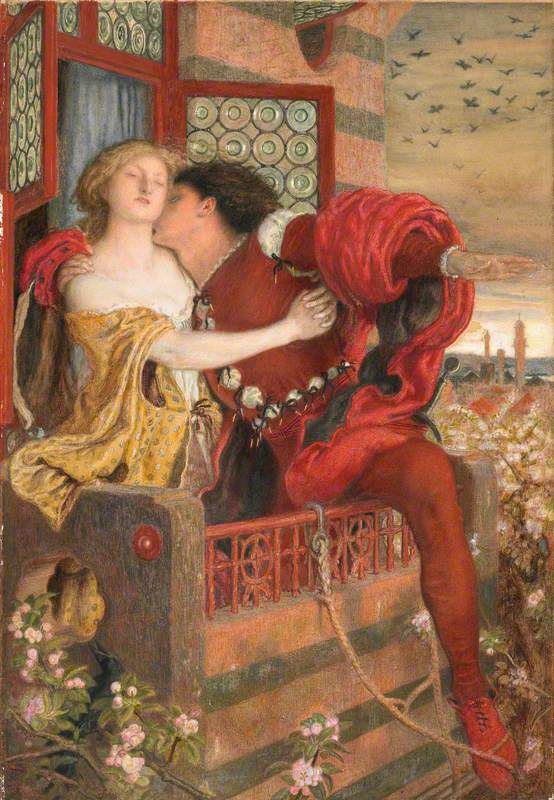
While some artists have been drawn to the tragedy of the story, in the nineteenth century artists were swept away by the romance. Ford Madox Brown (1821–1893) shared the aims of the Pre-Raphaelite painters who rejected the rapid industrialisation of their world and revered the early on Renaissance ideal of beauty.
Spurning the conventions of university fine art education they used brilliant colour to celebrate the historic by, glorifying nature and placing an accent on emotion and subjectivity which reflected the concurrent Romantic movement in literature and art. The Pre-Raphaelites created a list of 'Immortals' and placed Shakespeare among them.
In this painting of the scene following the nighttime that the young newlyweds have just spent together in secret, Romeo, burying a last kiss in Juliet'south cervix, gestures urgently with his left manus to bear witness her that he must go out earlier they are discovered by her mother Lady Capulet. Madox Chocolate-brown conveys the passion and distress of the moment in the lovers' intertwined bodies. The billowing rich silks of Romeo's red costume suggest the fire of his dear, while Juliet glows like an icon in golden. The artist meticulously details the apple blossom growing just below, alluding to Romeo's before remark that 'this bud of love, by summertime'due south ripening / May bear witness a beauteous flower when next we encounter'.
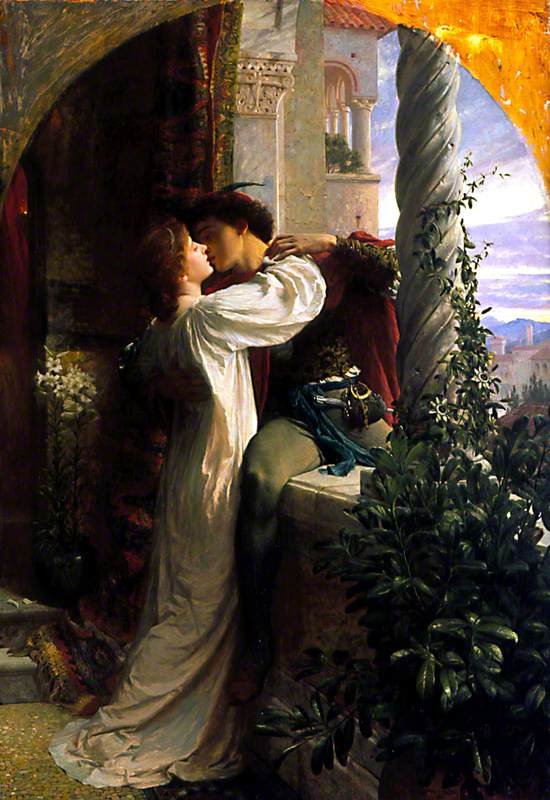
Voted as Uk's almost romantic artwork in a recent poll, Frank Bernard Dicksee's painting of the same scene reflects a growing tendency for sentimentality in Victorian painting. This work is based on an analogy he created in the 1880s for a luxury edition of Romeo and Juliet and embodies Romeo's line 'Bye, good day, one kiss and I'll descend'.
His detailed depiction shows the balcony from within, with the gilt light of dawn, the sign that Romeo must leave, illuminating the outer curvation which frames the city of Verona in the distance. The couple are framed symbolically on one side by a passionfruit climber, its flowers in full bloom, and on the other past a bunch of white lilies that seems to foretell their deaths. Dicksee drew heavily on history and legend in his work and was influenced by the chivalric bailiwick thing and intense colours used by the Pre-Raphaelites.
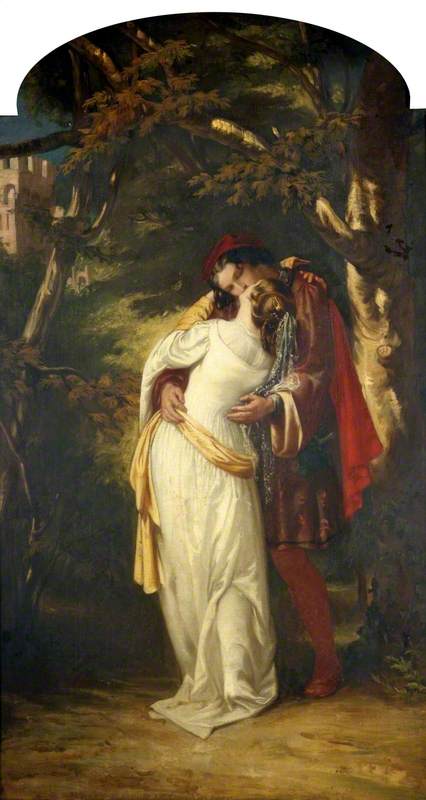
Whilst the Romeo and Juliet of Victorian paintings are portrayed as real people whose tragic circumstances are designed to evoke our sympathies, there is a long tradition of art that captures the theatrical productions. No one did more to revive Shakespearean theatre in the eighteenth century than the influential playwright, producer and role player David Garrick. Garrick revolutionised theatre by doing away with the previously formulaic declamatory style of acting and introducing a much more naturalistic mode of performance. He played numerous Shakespearean roles and managed the Drury Lane Theatre for 29 years, bringing Shakespeare to mass audiences and reviving many Restoration dramas.
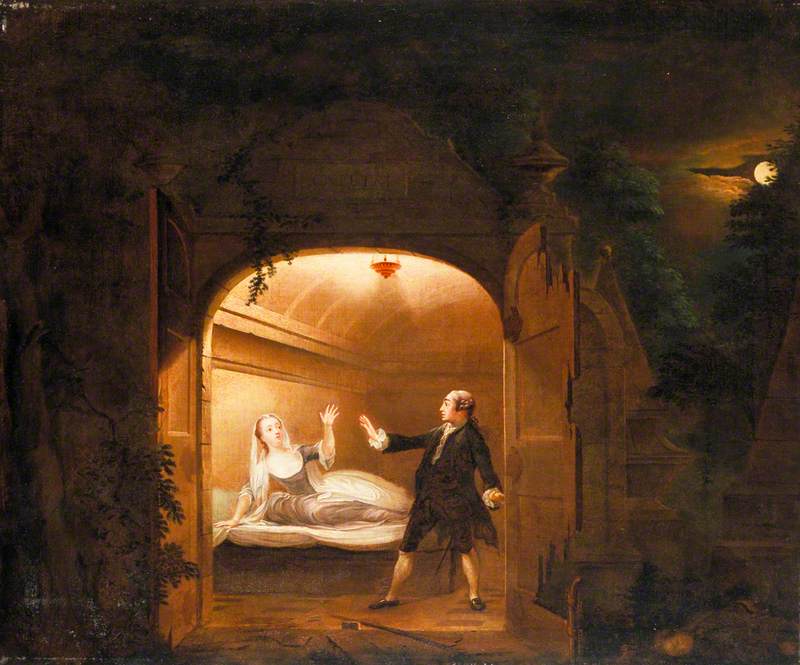
This 1753 painting of the tomb scene is one of iii versions by Benjamin Wilson on Art U.k. and represents Garrick's actual staging, with the Capulet tomb set towards the back of the phase. This enormously popular work spawned many engravings and other iterations such every bit box lids and enamel plaques. Garrick as Romeo stands in a feature pose of recoil, seen in other artworks, as he witnesses Juliet come back to life just afterwards he has taken a lethal toxicant.
To mod audiences, it may await odd to see the lovers both all the same live when Shakespeare's text has Juliet waking only after Romeo has perished, but Garrick reworked the scene to allow the lovers the adventure to say their farewells, a tradition that endured well into the nineteenth century. In a notorious theatrical battle of 1750, competing productions of the play were mounted at the Drury Lane and Covent Garden theatres with Garrick's Juliet, played by the actress George Anne Bellamy, gaining the best notices. It may be this product shown here.
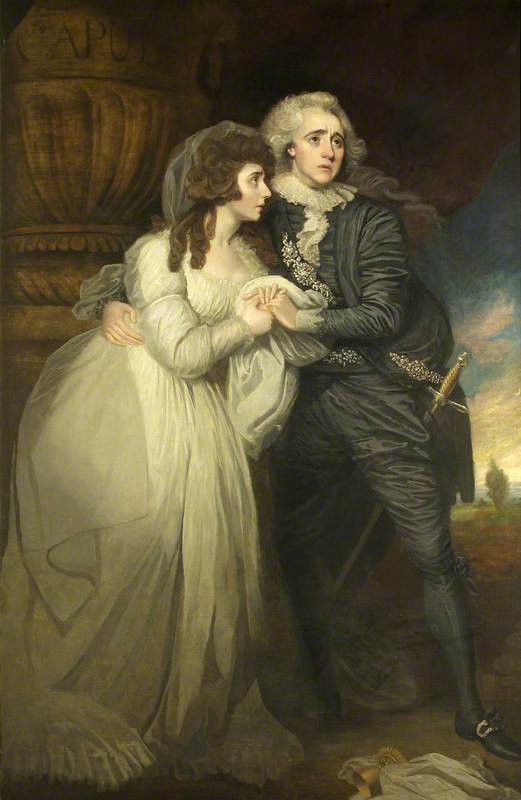
Retaining the Garrick estimation merely in a distinctly different version of the tomb scene, here we see the lovers in their final moments with the overturned cup of poison lying at their anxiety. It was non unusual for actors in the eighteenth century to wear contemporary courtly dress in their roles, something which may look strangely anachronistic to the modern eye, but which bears comparing with a production today featuring the lovers in t-shirts and jeans.
This Juliet, Anne Brunton, came from a theatrical family – her father managed the Theatre Majestic, Norwich. After she moved to Philadelphia in 1796 with her beginning husband Robert Merry she played Juliet again at the Chestnut Street Theatre. Joseph Holman is known to have played Romeo in 1784 at the Covent Garden Theatre, a production that may have inspired this work. He likewise moved to Philadelphia, where he managed the Walnut Street Theatre.
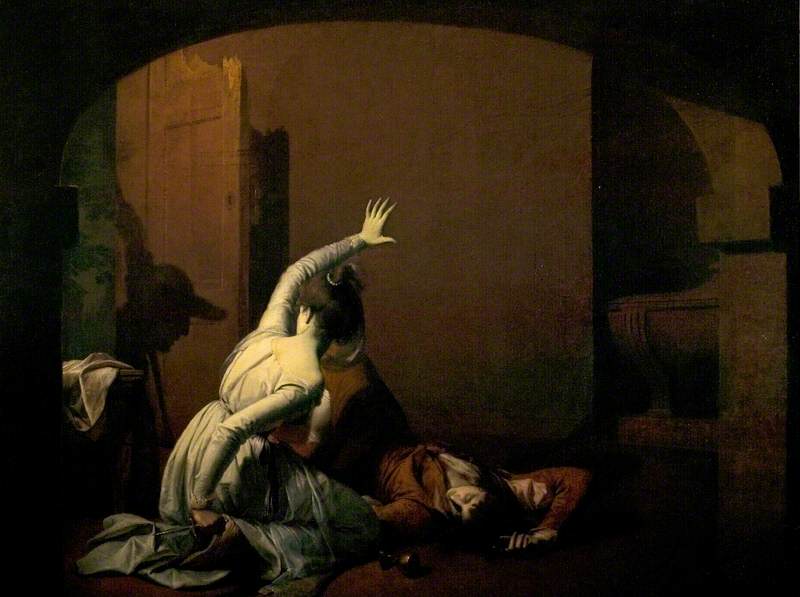
In Joseph Wright of Derby's searing revelation of the tragic concluding scene, Juliet, weeping over her dead lover, is disturbed by an approaching guard whose shadow we encounter in the doorway. Wright employs his mastery of calorie-free to illuminate her as a awe-inspiring figure in the moment before she uses a dagger to bring together her husband in death.
This painting was among many made for the Shakespeare Gallery initiated in 1876 by engraver and publisher John Boydell. Artists such every bit Joshua Reynolds, Robert Smirke, James Northcote and John Francis Rigaud were commissioned to create artworks for the gallery, but when Wright discovered that he had been consigned to a secondary and less well-paid class of painters he consequently had a row with Boydell which resulted in this painting being rejected.
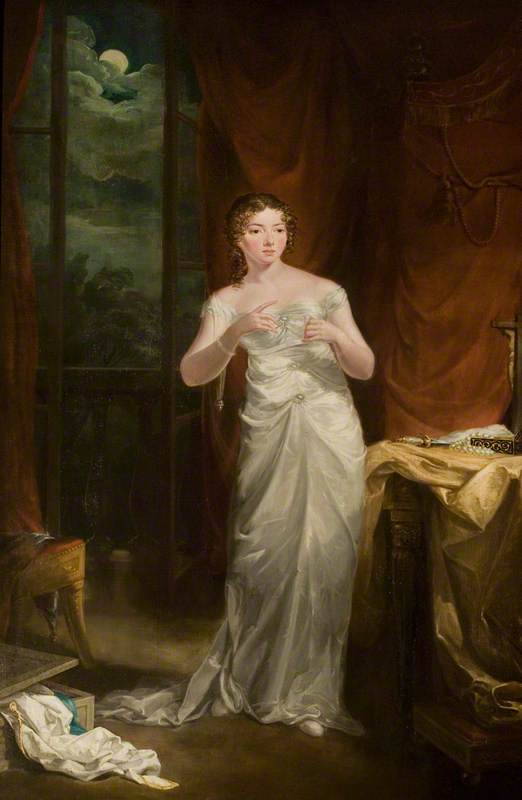
More frequently than not it is indeed Juliet rather than Romeo who is the focus of the artist. Sally (Sarah) Berth, seen here, opened the 1827 flavour at the Georgian Playhouse Wisbech (at present the Angles Theatre) every bit Juliet. Described as 'modest in stature, nervous, with hair inclining to carmine' she was ofttimes bandage in juvenile roles. At this moment, having been betrothed against her volition to Paris (and already secretly married to Romeo) Juliet stands in her bed-sleeping accommodation under an ominous moon, contemplating the herbal draught that will put her into a semblance of sleep.
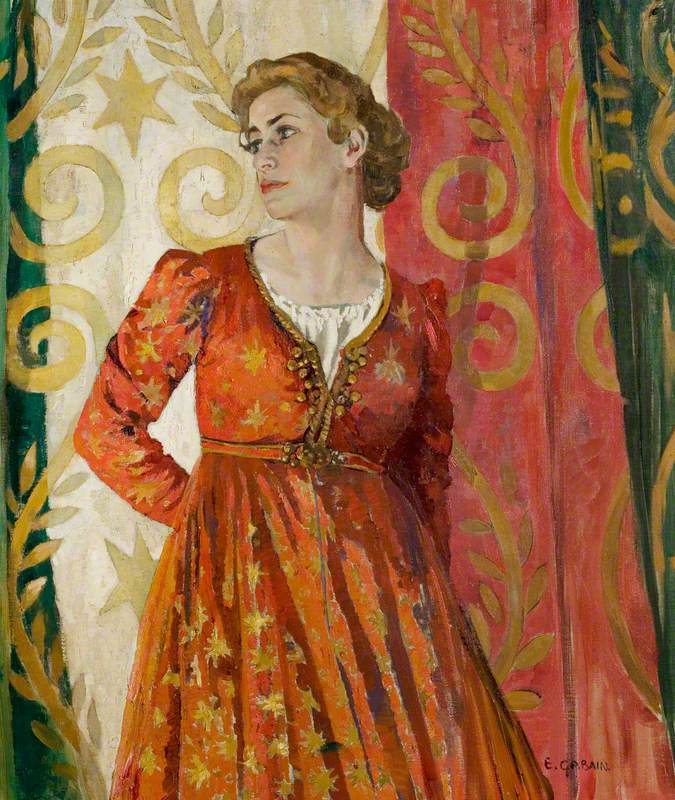
Ane of the twentieth-century theatre's most renowned Juliets, Peggy Ashcroft played the part for the 2d fourth dimension in 1935 under John Gielgud's management, with Edith Evans equally the Nurse, earning glowing reviews. The role of Romeo was taken on alternate nights by Gielgud and Laurence Olivier. Ethel Léontine Gabain was known for her oil portraits of actresses in character and was especially drawn to depictions of women in a land of melancholy. She gained a prestigious reputation for her lithographs and was elected President of the Guild of Women Artists in 1940.
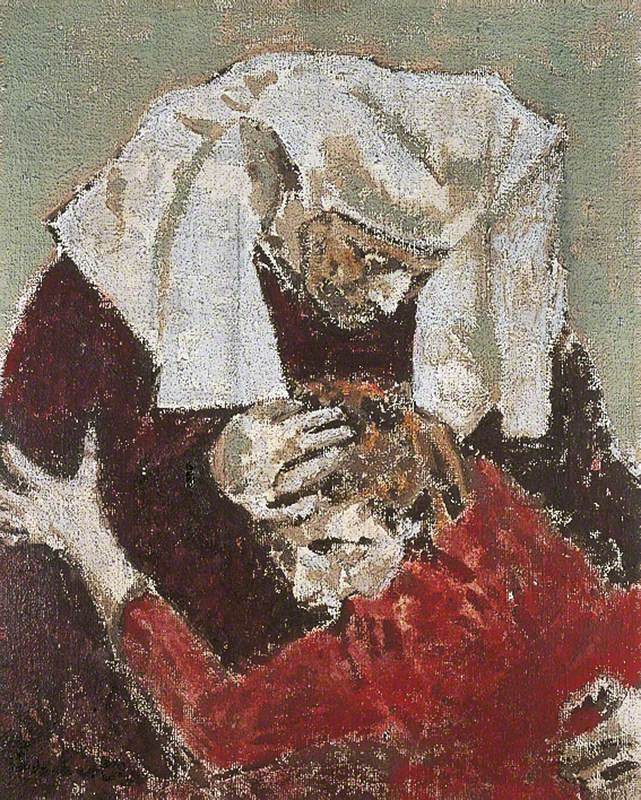
The aforementioned theatre production features in Walter Richard Sickert's moving depiction of Juliet with her nurse. A frequent theatregoer, Sickert made many friends amongst actors and painted Peggy Ashcroft and Edith Evans several times. His technique of flat dry-scraped paintwork, seen here, often left bare patches of canvas visible and allowed for expansive flat patches of tonal colour. The graphic fashion owes something to Sickert'southward method at this fourth dimension of painting from press images and embodies the simple heartache of a immature girl in the throes of love, cartoon comfort from the 1 person she tin trust.
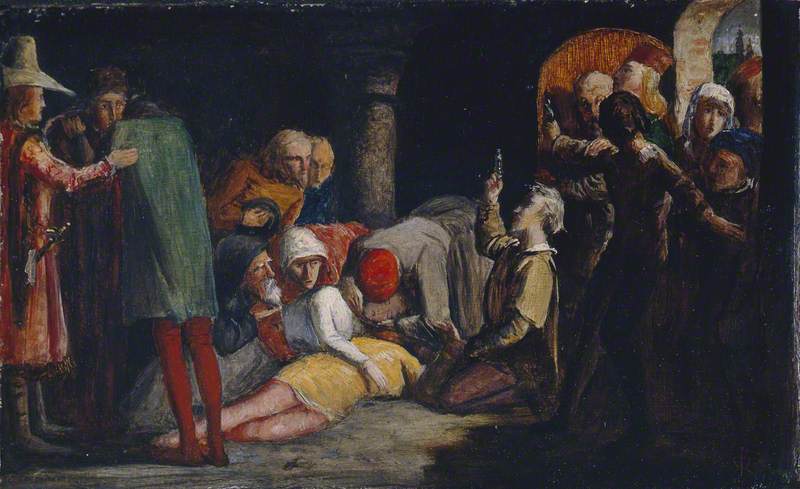
In this tiny oil painting (sixteen.ane x 26.ix cm), perhaps a study for a larger piece of work, John Everett Millais marks the 'fearful passage' of Romeo and Juliet's 'decease-marking'd honey' with a tableau of the final scene where the Montague and Capulet families agree to be reconciled. The intensity of colour and use of natural light to illuminate the scene are typical of Pre-Raphaelite sensibility. Past placing the bodies of the lovers in the eye he cuts the painting across the diagonal, reminding the states of the sectionalisation between the families that volition ultimately be healed by the tragedy.
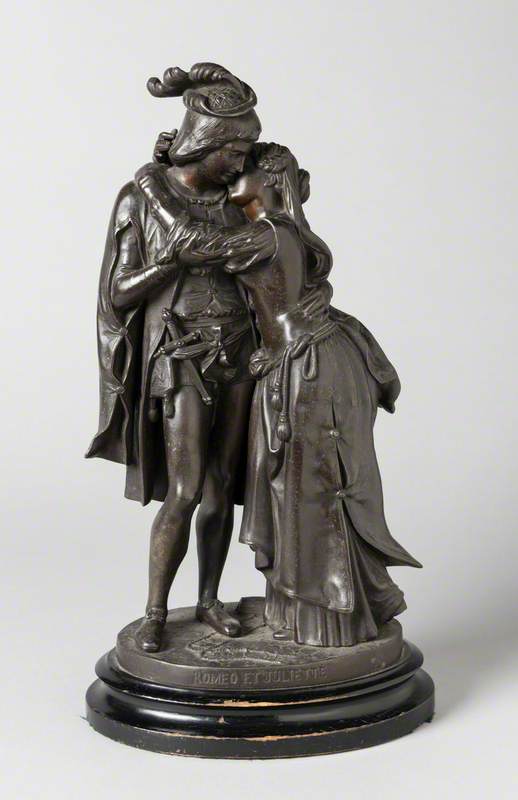
This story with its indelible theme of young love thwarted and doomed by prejudice and misunderstanding remains relevant for every age and volition go on to be the spur to new interpretations.
Lucy Ellis, freelance writer
More stories
Artworks
Source: https://artuk.org/discover/stories/star-crossed-lovers-romeo-and-juliet-in-art
0 Response to "Art With Romeo Juliet as Theme Romeo and Juliet Inspired Art"
Postar um comentário